Are silk nightcaps counterproductive? A new haircare norm to achieve beautiful hair while preventing "scalp problems caused by stuffiness"
Nightcaps have become a staple hair care item.
But won't wearing one make your head stuffy and cause hair or scalp problems? Is there really a point to wearing a nightcap? Is 100% silk best? You may have questions like these.
To give you the conclusion first: if you choose or wear a nightcap the wrong way, it may not only fail to work but even be counterproductive.
But once you know how to use it well, you can feel the difference right away, and it lasts a long time once you buy it. Used together with a shampoo and treatment that suit you, it creates a welcome combined effect.
It is a hair care item worth getting on your side the right way.
Nightcaps were born in medieval Europe to prevent lice and keep warm at night. Today, they are used to protect hair from dryness and friction.
For an explanation of why nightcaps help with hair care, see this article.
What is a nightcap? As important as shampoo: a physical barrier that stops hair damage
In this article, the author, a certified hair diagnostician who has tried many nightcaps and develops original ones, introduces three concrete examples of how a nightcap can become counterproductive.
Counterproductive nightcap 1
"Wearing it over damp hair"
When hair is wet, the cuticles absorb water and soften, which makes them easy to chip or peel off with rubbing. On top of that, damp hair that dries while pressed into a shape keeps that shape as a kink.
What's more, wearing a nightcap over wet hair traps moisture, making the inside of the cap stuffy and letting bacteria multiply. More bacteria on the hair and scalp can cause itching, dandruff and odor.
In other words, a nightcap you started using to make your hair beautiful can cause trouble if you use it without drying your hair.
By the way, leaving a towel cap on for a long time also causes stuffiness and bacterial growth, so the key to hair care is to dry your hair soon after your bath.
How to wear a nightcap without causing scalp or hair problems
So how can you get the benefits of a nightcap without trouble?
The answer is simple. Dry your hair thoroughly before putting on a nightcap. Take it off when you are sweating. Just following these rules lets you get the most out of your nightcap.
- When the air is dry (in cold seasons, or in summer with the air conditioner on)
: A nightcap that protects against dryness is the best choice - When you tend to sweat
: A pillowcase that doesn't cover your head is the best choice
In short, what to choose depends on the season and your bedroom. Compare which one suits you now.


Counterproductive nightcap 2
"The size or shape doesn't fit"
If you already use a nightcap, you may be unhappy that it falls off or doesn't feel right.
Even if it has come off by morning, many people seem to feel the benefits as long as they wore it for most of the night. But if it falls off as soon as you turn over, you can't expect it to reduce the friction of tossing and turning.
And continuing to use an uncomfortable nightcap for the sake of beautiful hair, at the cost of your sleep, would be putting the cart before the horse.
If your current nightcap falls off or feels uncomfortable, in many cases the cause is that it doesn't match your head shape or hair length.
Nightcaps made entirely of knit fabric, or with elastic all around the opening, feel relaxed but tend to have a weaker hold and come off more easily.
What to do if your nightcap's size or shape doesn't fit
It may be worth switching to a nightcap that suits you.
Today you can find nightcaps designed for different hair lengths, and for size, measuring your head before you buy helps you avoid mistakes.
If you switch because the shape doesn't match your hair length, we recommend keeping the old one rather than throwing it away. It may come in handy the next time your hairstyle changes.
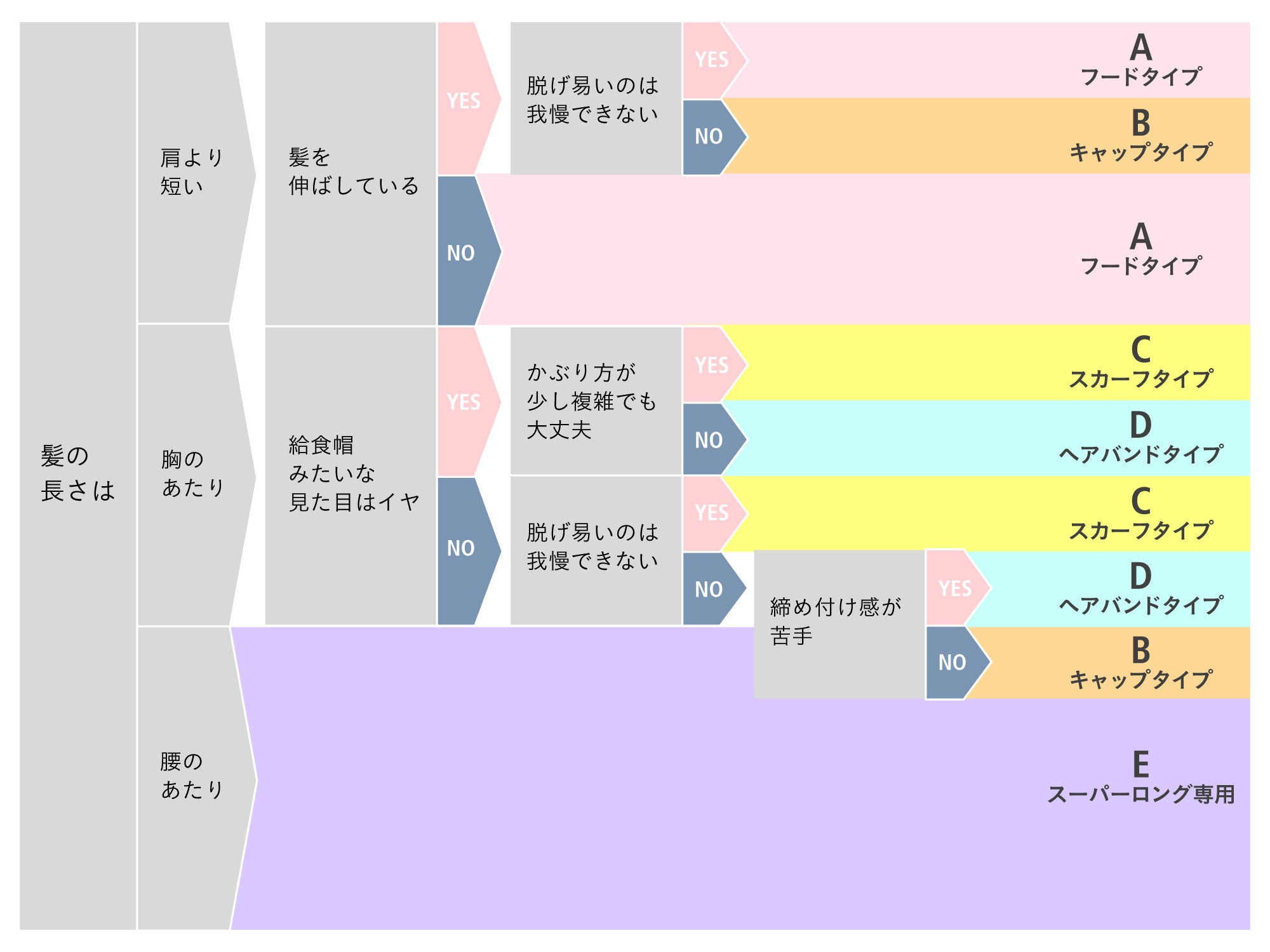
Choose by your current hair length and the fit you prefer.
 Gathers and wraps hair longer than your shoulders: HAIR CREPERIE
  Tied under the chin so it stays on: SISTER
  Adjust by how you tie it, for any hair length: Premium
Counterproductive nightcap 3
"The material trap"
You may want to start with an affordable nightcap just to try one. When you look for something inexpensive, the material is exactly what you should check.
First, let's think about why wearing a nightcap helps with hair care.
- Holding: the nightcap holds hair in place, preventing tangles and "friction" between strands
- Shielding: the nightcap shields hair from outside stress such as the "friction" and "dryness" that come from contact with pillows and sheets
- Low friction: a finely woven fabric reduces "friction" between hair and nightcap
Any cap shape can achieve 1 and 2 to some extent. For 3, even polyester can reduce friction if the fabric is fine enough to have a visible sheen.
So why is silk so often used for nightcaps?
Because silk, like hair, is a fiber made of protein.
Polyester and similar fibers are a kind of plastic, but silk, like hair, is a protein made of amino acids, and is close to hair in nature.
When hair rubs against polyester and similar fibers, static builds up easily, and the charged strands repel each other, spreading out and becoming hard to manage.
Silk, on the other hand, is close to hair in nature and is less likely to generate static.

As the diagram shows, the cuticles on the surface of hair are held together by CMC, which works as an adhesive, and their surface is coated with a lipid (18-MEA) that keeps it smooth. When rubbing is repeated, for example by tossing and turning, this lipid and adhesive are gradually lost, the cuticles lift, and eventually they peel off. That is why it matters to reduce rubbing with the material that touches your hair.
Also, synthetic fibers like polyester repel moisture instead of absorbing it. When sweat from your scalp is trapped inside the cap while you sleep, damp hair can take on kinks and bacteria can multiply, which really is counterproductive.
Silk, by contrast, both absorbs and releases moisture, so humidity is less likely to build up inside the cap.
The material we hope you choose when buying a nightcap
If price comes first, many options are made of polyester.
But as explained, synthetic fibers like polyester can build up static that makes hair spread out, or repel sweat and make the inside of the cap stuffy.
We recommend choosing silk or other natural materials that are less likely to generate static whenever possible.
Made to be used with confidence: ITSUKI nightcaps, built on the designer's ideals
"I understand the materials, but which one is best for me right now?" Many people probably wonder this.
ITSUKI offers items suited to your lifestyle and hairstyle.

No matter how much hair care I did at night, my hair in the morning was so tangled and dry that it snapped every time I ran a comb through it. ITSUKI nightcaps were created to put an end to the designer's own frustration.
Every model is carefully designed so that the shiny side of the silk faces the inside of the cap rather than the outside, without giving up on its look as a head accessory.
And to make wearing a nightcap a habit, durable cotton is woven in throughout, with no compromise on ease of care.
All so that you can keep using it with confidence.
If you are not satisfied with the nightcap you use now, we especially hope you will try an ITSUKI nightcap.
FAQ
Q. Can a nightcap be counterproductive?
It can, if you choose or wear it the wrong way. The main causes are: 1. wearing it over damp hair, 2. a size or shape that doesn't fit your head or hairstyle, and 3. synthetic materials that generate static. Used correctly, a nightcap keeps bedhead down and protects your hair from dryness and friction.
Q. How can I keep my nightcap from getting stuffy?
Most important is to dry your hair thoroughly before putting it on. Wearing it over damp hair makes the cap stuffy and lets bacteria multiply, which can cause itching, dandruff and odor. Choosing silk, which both absorbs and releases moisture, also makes humidity less likely to build up inside the cap.
Q. Why is silk good for nightcaps?
Silk, like hair, is a fiber made of protein and is close to hair in nature, so it is less likely to generate static. Synthetic fibers like polyester build up static that makes hair spread out, and can repel moisture and make the cap stuffy, while silk both absorbs and releases moisture, so humidity is less likely to build up.
Q. Why does my nightcap keep falling off?
The main cause is that the nightcap's shape and size don't match your head shape or hair length. Nightcaps made entirely of knit fabric or with elastic all around the opening have a weaker hold and tend to fall off. Choosing a model designed for your hair length helps.