What is a nightcap? As important as shampoo: a physical barrier that stops hair damage
You spend time choosing the right shampoo and treatment and add something good for your hair before bed, yet by morning it is dry and frizzy. Or it snaps as you work out the tangles. Does that sound familiar?
That's right. The incident happens while you sleep.
To give you the conclusion first: a nightcap is a basic of hair care, as important as shampoo and treatment, that physically stops the friction your hair faces during sleep.
Metal combs have become popular as hair care items that focus on the friction of brushing, but during sleep your hair is even more defenseless, exposed to strong friction for hours.
How should we take care of the "other half" of hair care, the hours we have literally closed our eyes to?
As the founder of a nightcap brand launched seven years ago and a certified hair diagnostician, I will explain what really happens.
Hair damage caused by friction
It may be a little surprising, but hair cells are already dead (keratinized) the moment they grow out.
Just as a chipped nail, another appendage of the skin, does not regrow only the chipped part, hair does not repair itself once it is damaged by friction or heat.
This is why we need to keep hair clean with shampoo and replenish it with treatment every single day.
If so, you would want to keep your hair in the state it was in after your bath for as long as possible.
But in many cases, doesn't it go like this?

- Take a bath and care for your hair
- Sleep
- Wake up with messy hair
It seems like ordinary daily life, but something irreversible happens at "2. Sleep."
For eight hours of sleep, your defenseless hair keeps rubbing against the pillow every time you turn over, and the nourishment you worked to add gets worn away.
Here is a diagram of the structure of hair.

The scale-like protein on the surface of hair is the cuticle, and the hard, fibrous protein inside is the cortex. The surface of the cuticle is coated with a lipid (18-MEA) that, like floor wax, keeps it smooth. The scales, the fibers inside, and the scales and fibers are held together by an adhesive made of lipids and proteins called CMC.
...until you fall asleep.
- Friction's crime 1: Every time you turn over, your hair rubs against the pillow, and the surface wax (18-MEA) and the adhesive between the scales (CMC) are gradually lost. Hair that has lost its smoothness rubs even more easily, and cuticles with weakened adhesion lift up. As friction continues, the cuticles eventually peel off and the hair loses its shine. Hair charged with static from the rubbing repels itself, strand by strand, and spreads out into morning frizz
- Friction's crime 2: When the scales lift or peel, even the adhesive that bundles the hard fibrous protein inside flows out. The hair becomes thin and eventually leads to breakage and split ends
Here is the scary part. The surface cuticle can be made smoother with treatments and hair oils, but the adhesive inside the cortex is hard to replenish. That is why it is wise to stop the damage before the adhesive is gone.
This is the true nature of the incident we need to prevent during sleep. The lipids and adhesive lost to friction are exactly the "nourishment" we try to add with shampoo and treatment. They are what we need to protect for beautiful hair.
Rest assured, a nightcap can prevent this incident before it happens.
TIPS: I sometimes hear people say they don't need a nightcap because they shower in the morning. Bedhead may not bother you, but considering the damage friction does to your hair, it is still worth protecting it.
Three functions of a nightcap

Here are the functions of a nightcap that protect your hair's nourishment.
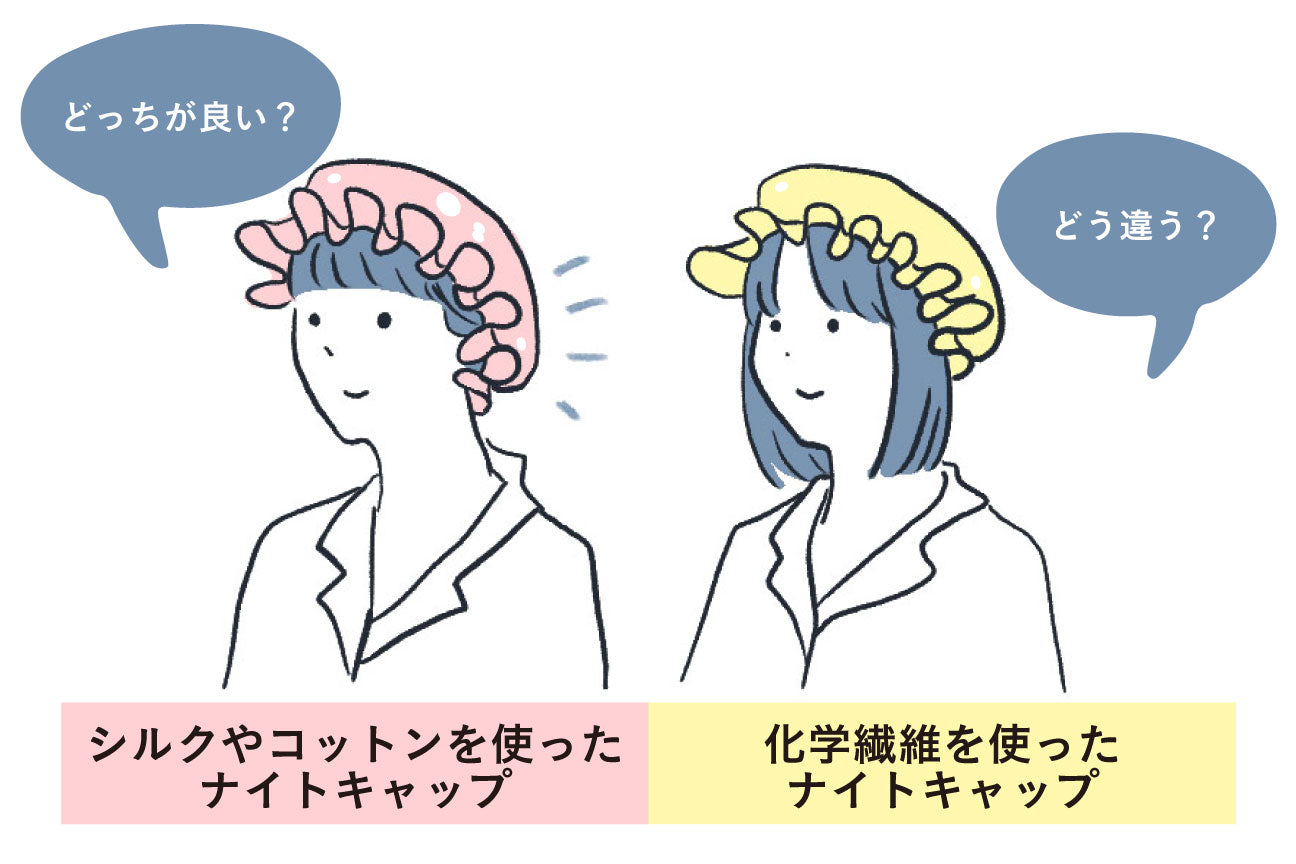
- Friction barrier: Silk has fibers so fine and a surface so smooth that you can see its sheen. Hair slides over it without catching, and because silk is similar in nature to hair, it is less likely to generate static. Wrapping and securing your hair in a silk nightcap protects it from the friction between hair and pillow, created between the weight of your head and the pillow pushing back, from friction between strands, and from static
- Dryness barrier: Wrapping your hair protects it from the dry air of air conditioning and heating. Silk is a material that both absorbs and releases moisture. Wearing a nightcap helps keep your hair the way you cared for it after your bath until morning
- Heat damage barrier: Wearing a nightcap keeps bedhead down. It is a little-known benefit, but when you wet your hair to fix bedhead, brushing and the heat of the dryer hit cuticles that have softened with water. Avoiding that not only saves time on the flat iron and dryer in the morning, it also helps prevent the dryness, loss of strength and elasticity, and breakage caused by accumulated heat damage. Breaking this negative cycle protects your future hair too
A silk pillowcase can also reduce rubbing and keep bedhead down, but a nightcap, which wraps and secures your hair, goes one step further against both friction and dryness. For those who want stronger protection, a nightcap is the best choice.
Because it keeps your hair gathered inside the cap, a nightcap is also recommended if you are bothered by hair touching your face or neck while you sleep.
ITSUKI nightcaps
ITSUKI started in 2019 from my own hair troubles. When the designer appeared on NHK's "Asaichi," nightcaps were still rare. Now they have become a hair care staple.
But after becoming a certified hair diagnostician, I noticed something.
"Friction during sleep" is a blind spot in hair care that even specialist books largely pass over.
Nightcaps, which address this blind spot, have the potential to change the premise of hair care.
Now that more brands offer nightcaps than seven years ago and there are more choices, here are the points that make ITSUKI different, compared with other products.
-
The face of the fabric touches the hair
In many other products, the back of the fabric, which feels rougher than the face, touches the hair. ITSUKI nightcaps are designed so that the face of the fabric touches the hair, prioritizing less friction -
Models designed for different hairstyles
A nightcap leaves odd marks in your hair when it is not designed for your hairstyle. At ITSUKI, the designer actually changes her own hairstyle to match each item in development and uses samples every night to find the best shape -
Comfortable, with no unnecessary frills
Even if you use a nightcap because it is good for your hair, it is hard to keep using if frills irritate your skin while you wear it. ITSUKI removes unnecessary decoration so that every item is comfortable to wear -
A look you want to wear
If the person in the mirror is not who you expected, or your family teases you, it is hard to keep wearing a nightcap. To help you keep using it, we care about how it looks as much as how it feels.
ITSUKI offers several nightcaps. We have prepared an easy chart to help you find the model that suits you best.

Nightcaps plus the right shampoo and treatment
For seven years since the brand started, I, the designer, believed that "a nightcap is all you need" for hair care. Now that I am a certified hair diagnostician, I can say this with confidence:
- A nightcap (or pillowcase) to stop damage
- Shampoo and treatment to replenish nourishment
Unless you have both, your hair care efforts will go to waste.
Replenish with a shampoo that suits you, and protect it with a nightcap. That is all it takes.
But just like me before I studied, few people can confidently choose a shampoo and treatment that suits them, rather than following trends or reviews. So I created the "Shampoo & Treatment Diagnosis," packed with what I have learned.

The results of this diagnosis are sent through our newsletter.
Why does a nightcap brand talk about shampoo?
Simple. We want everyone to be free from the time spent choosing hair care products!
Feel the combined benefits of a nightcap and the right shampoo and treatment for yourself.